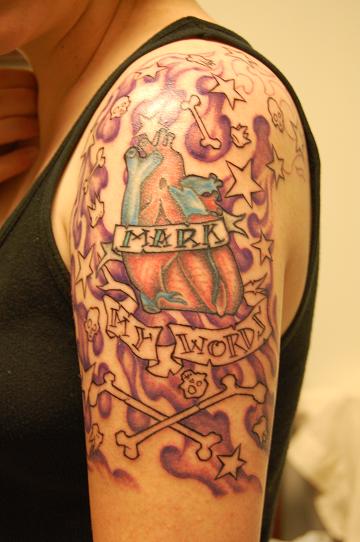
The glare on the picture kind of sucks, but can't you just smell the A&D ointment?
We're about 2/3 done. I'm so pleased.
]]>Of course, my eyes were already closing before we got through the 18 minutes (!) of previews.
It is bad form to fall asleep during a hotly anticipated film. It is even worse form to do so in the theater, surrounded by people who are actively engaged, laughing and shouting things at the screen. There is, however, a delicate protocol which will help you and those around you save face should you find yourself falling asleep:
Begin by assuming a casually “comfortable” posture. Slouch into your seat, legs braced against the seat in front of you. Cross your arms so that, should you actually fall asleep and lose muscle control, your arms will not fall into your neighbors’ laps and give either the impression that you are sleeping or that you are making clumsy and untoward sexual advances. Tilt your head back and stare at the screen through half-closed eyes. This makes it harder for your neighbors to ascertain when you have actually closed your eyes completely.
Next, the most important part: facial control. Assume an expression of calm, somewhat superior appreciation. A half-smile would be too much here; a quarter-smile will do. Maintain this expression even while asleep. This will give your neighbors the impression that you are deeply engaged in the movie, and they will forbear from commenting to you or asking you whether you are liking it. Should they eventually puncture your sleep with a comment, or should laughter or other noises from the theater momentarily wake you, take this as an opportunity to open one eye, register quickly what is happening onscreen, and respond cautiously. DO NOT ATTEMPT actual words; instead, issue the following laugh:
“Hmmmhmmhmm.”
Resume sleep. If you can, try to resist the deep, even breathing of the sleeping person, which will be instantly detected. Breathe instead in irregular sniffs. Inhale as though you have the sniffles or as though you are filing something away for future thought. Exhale with derision, as though you find something amusing, but not amusing enough for a real laugh. Lastly, be sure to wake up as soon as the end credits begin. Issue the laugh again, preparing your vocal cords for the coup de grâce: you must turn to your neighbor before he turns to you, and you must smile brightly and chirp, “Wasn’t that great?” He, who has actually resisted the pull of sleep, will be tired and slow to respond; this buys you time to stretch, yawn, find your shoes, and prepare to shuffle out of the theater.
Clearly, I have done this a lot. It’s not that I don’t like movies; I LOVE movies, which is probably why I spend a lot of time watching them when I should probably be home in bed. The problem is mainly that I am perennially overtired, and that I do not often get to sit down after 9 PM in a comfy chair for purposes other than doing work. When it does happen, my body naively assumes that I’ve decided to go easy on it and let it get some sleep. I realized dreamily the other night, staring at the screen through half-lidded eyes, that there are a lot of movies I’ve simply never seen the end of (or, in many cases, the middle) and consequently have only the vaguest idea of what they’re actually about. Here follows a partial list that occurred to me between sniffs and snorts.
I assure you that there can be no spoilers whatsoever in the following list.
Hellboy II: The Golden Army. “Seen” in theater Thursday night.
What it appears to be about: Selma Blair has some stomach trouble. Hellboy and Abe Sapien drink several six-packs of Tecate. There are tooth fairies that look exactly like creatures that director Guillermo del Toro may have had left over from his work on Pan’s Labyrinth. There are also a super-Goth, beautiful, blond brother and sister who are best friends and read Tennyson to each other. Hellboy, or possibly someone else, gets stabbed with a spear.
Remaining mysteries: Most of the content of the movie.
Trainspotting. One of the most celebrated movies of my college years; “seen” in a late-night showing in Wheeler Auditorium on campus.
What it appears to be about: Ewan McGregor and some friends have fun on heroin. They get up to a lot of highjinks like toilet diving and staging a puppet show with a baby doll crawling across the ceiling.
Remaining mysteries: The title of the movie; is there a train? When will they ever show the dark side of heroin addiction?
Star Trek: The Motion Picture. “Seen” in living room of friend’s house during college.
What it appears to be about: A giant, malevolent entity heads toward Earth. The Enterprise would be the ideal ship to stop it, but the ship’s undergoing repairs and the crew is all scattered. Earth will be destroyed, foreclosing the possibility of future Star Trek TV series or movies.
Remaining mysteries: Then how did we get 4 more TV series and Star Trek movies II through X?
Pulp Fiction. One of the most celebrated movies of my high school/college years. “Seen” in a theater in LA.
What it appears to be about: Uma Thurman lies on a bed reading a novel. Sorry, that’s from the movie poster, which is the only thing I stayed awake for.
Remaining mysteries: What do the French call a Filet-O-Fish sandwich? Le Filet-D-Poisson?
2000 elections. “Seen” on internet and TV from work, from bar, from my couch, and finally from my living room floor.
What they appeared to be about: Al Gore became the 43rd president.
Remaining mysteries: What the hell happened between 2 and 6 AM while I was asleep?
Groundhog Day. Apparently one of the funniest movies ever made; “seen” on DVD from my comfy chair.
What it appears to be about: Bill Murray, a poor overworked weatherman stuck doing a stupid story about groundhogs, has a crappy day on February 2 in a podunk town in Pennsylvania.
Remaining mysteries: After he gets a good night’s sleep, does he wake up to a better day on February 3? One certainly hopes so.
As a lifelong Batman fanatic, I am terribly excited for The Dark Knight. Specifically, I am excited about getting out of class on Friday, well-rested from my sleep in the theater the night before, and sneaking off to a matinee to re-watch the movie and figure out what happens before I have to talk to anyone about it.
]]>Hammy English Winter Vegetable Stew with Ale and Stilton
½ lb. disturbingly named “ham ends” (can also use hocks, other cheap ham pieces designed for stewpot)
3 cloves garlic, minced
1 small onion, diced
2 ribs celery, diced
2 small or 1 large carrot(s), diced
2 parsnips, peeled and diced
5-6 small red potatoes, diced
4-5 cups vegetable stock
½ - 1 cup ale (any kind, not too dark, not flat)
½ head cabbage, cored, rinsed & chopped
¼ cup Stilton or other blue cheese, crumbled
Butter/olive oil, for sautéing
¾ c dry elbow macaroni
1 c frozen lima beans, carefully inspected
Thyme, dried or fresh
Dill, dried or fresh
MAYBE salt, but not until very end when you’ve tasted the stew with everything else added!
Sauté garlic and onion in olive oil and/or butter until just fragrant and soft, stirring to make sure garlic doesn’t burn. Add ham pieces and stir. It’s easiest if your ham ends, hocks, or whatever are in big chunks at this point. At any rate, stir them in for a minute or two until fragrant, and just searing on the outside. Add diced celery, carrot, parsnip, and potatoes and stir to coat in oil/butter for a minute or two.
Add your veg stock and bring to a boil. Reduce to simmer, add ale, and simmer 40 minutes or so until the ham is tender. Pull the ham chunks out of the pot, get the meat off the bone, dice, and return to pot.
Add cabbage and simmer 10 minutes.
Add lima beans, elbow macaroni, and 2 sprigs each thyme and dill, if using fresh; otherwise, a pinch or two each of dried or to taste. Cook a further 10 minutes or until macaroni are cooked.
Last thing: Add crumbled Stilton and stir in. Remove from heat and check seasonings. I found that between my vegetable stock, which had salt in it, and the salty ham, and the salty Stilton, I didn’t need any additional salt. And I like salt. So make sure you check your seasonings after adding the cheese and before auto-salting. Also, depending on how much you like blue cheese, you could go up to 1/3 c or so.
Makes a fucking ton of stew. As it sits in the refrigerator, your leftovers will turn from stew into a casserole as the macaroni absorbs all the liquid. Delicious, particularly if you're on vacation from veganism.
]]>The Monticello trip was several Saturdays ago. I arrived in the lobby to meet the students at 6:45 AM, and things started unraveling immediately. First of all, the trip was to be accompanied by Professor Difficult, a faculty member and general hanger-about the Center who had already deeply endeared himself to me by calling my advisor back home and telling him that I need to work harder on my dissertation. When he arrived in the lobby, the first thing he did was to make a beeline for me and kiss me on the cheek, a sweet and courtly old-man gesture that I particularly and uniformly despise.
As I was shooing away Professor Difficult and checking students off my list, I saw a man board the bus and make what appeared to be a lively speech to the students already on board, waving his arms. Then he got off the bus and came into the lobby. “Well,” he said, apparently to me, “I told ‘em I can’t go on the trip. So you got to talk to the driver, ‘cause he ain’t never been there before.”
His peculiar communication turned out to mean this: this man was the owner of the bus company, who was himself supposed to be driving our bus down to Monticello, a roughly 2-hour drive into Virginia. But, according to various accounts I later heard, it was either his 50th anniversary, or he wanted to go to a baseball game. Either way, he had made other plans. So he had assigned us a replacement driver who combined a maximum of age with a minimum of experience: a palsied octogenarian in a Coast Guard cap who had never driven to Monticello, or to the nearby town of Charlottesville, or to the rather out-of-the-way town of Manassas, or, as I later discovered, anywhere in the Washington DC area. For all I know, this man had flown out from the West Coast to visit his grandchildren and had been shanghaied into driving our bus.
All of this was imparted as I continued to check students onto the bus. In the middle of this, Professor Difficult began barking directions at me, directions which I failed to write down the first several times he yelled them, because I certainly wasn’t going to be driving any bus, and I assumed that he could re-deliver the instructions to the bus driver as and when needed. Except, as he then told me, he was planning to drive down separately. The given reason for this was that he needed to spend the night in Charlottesville. The actual reason for this, of course, was that he was clearly going to have more fun driving his shiny silver convertible than riding on a tour bus with a bunch of college students. So the third time he barked directions at me, I dutifully scribbled them down on a corner of my list of names. The directions I got read, in their entirety:
66 to 250 to 28 to 64E to 20? to Monticello (look for some signs)
Anyone familiar with Washington and Virginia will immediately see what was going to happen. Unfortunately, neither the bus driver nor I had any experience with the area, and so we were unable to identify what was happening even while it was happening. To wit, rather than taking Highway 29 toward Charlottesville, we took Highway 28 to, and well past, Manassas. For those of us educated in the North and/or West, this is where the two famed Battles of Bull Run took place. For those of us on the bus that day, sadly, it was very much not where we needed to be. In short, what should have been a two-hour bus ride took nearly four and a half hours. I took some comfort in the fact that by Hour Three most of the students were asleep on the bus and therefore unable to witness the bus driver repeatedly having to pull over and ask random drivers for directions.
Professor Difficult, who had smuggled a friend of his along for the trip, arrived at Monticello a full two hours ahead of us. Someone in the Center had leaked my cell phone number to him, which he used to call and let me know exactly how remarkable he found it that the completely uninformed bus driver and I had managed to get lost, how pissed he was that we were late, and how generally incredulous he was that I was unable, from my position as a passenger, to cause the bus to move any faster in the right direction. According to my phone’s call log, he called to berate me at:
10:11 AM
10:27 AM
10:33 AM
10:38 AM
10:47 AM
10:58 AM
11:03 AM
11:10 AM
11:13 AM
11:15 AM
11:16 AM
The last call came as the bus was pulling into the parking lot of Monticello’s Visitor Center, which was hailed with cheers by all aboard. I answered the phone and said, “We just got to the Visitor Center. Where are you and your friend waiting?”
“What do you mean you’re at the Visitor Center?” he said. “I mean, I just don’t understand it, Katie. What the hell would possess you to go there?”
So we started the bus back up and followed the directions that Professor Difficult had barked at me over the phone, which led us up the hill to a community college. Then we turned the bus precariously around, went back down the hill, then up another hill to a gated community. Then we turned the bus around, went back down that hill, and randomly picked another uphill route, not the one Professor Difficult had prescribed but which nevertheless got us to Monticello itself, or at least to its parking lot, whence one takes a shuttle up to the house at the top of the hill.
Only 2 ½ hours late for our tour, and in one piece, which I thought was pretty good. Students made a beeline for the restrooms and the food concession, and I got on the phone with the Center’s events coordinator to let her know what was going on. While we were on the phone, I watched in total horror as Professor Difficult started pulling my students out of line and ordering them onto the shuttles. “This man is insane,” I told the events coordinator. “I am going to beat him to death with a replica colonial butter churn.”
When I pointed out to Professor Difficult that I wanted to make sure the students got a chance to grab water and food, he punched me in the arm. “Oh, relax,” he said.
I was beyond words. Opening and closing my mouth like a fish, I followed him onto the shuttle. My friend Michele, who I had smuggled along on the trip for my own comfort and sanity, punched my arm. “Relax,” she hissed, and snickered.
Thomas Jefferson’s house is graceful and stately, overlooking a beautiful valley filled with greenery and slowly droning bumblebees. The house is magnificently filled with amazing objects of not-exactly his invention, and the grounds are beautifully maintained. I feel confident that it is the ideal sort of place for a convivial group to spend a relaxed afternoon, wandering the grounds and exploring at leisure. Unfortunately for that group, which on this particular day consisted of several dozen cheerful senior citizens, the 54 members of our group were marched through at grim speed, trailing thunderclouds in our wake. Tour completed, we stood at the top of the hill waiting for the shuttles back to the parking lot. Several students raised, not for the first time since we’d arrived, a plaintive chorus in favor of exploring the colonial-esque tavern at the bottom of the hill. The senior citizens beamed at the fresh-faced young college students. And Professor Difficult huffed and stamped.
At least, that’s how it went for the first ten or so minutes, while the senior citizens stood graciously aside in the sticky heat and allowed strapping young university students to completely fill the first two parking lot shuttles. But when the third shuttle arrived, an elderly man, leaning on his wife’s arm, tried to board. And then something happened which I have never seen before in my life: Professor Difficult came up behind the old man, took him by the shoulders, and pulled him off the shuttle. “We need our students to stay together,” he barked. “You can go on the next one.”
The next part of our itinerary was meant to include a leisurely lunch hour in Charlottesville before our afternoon’s architectural tour at University of Virginia. I had checked this with the events director because of the strict injunctions about keeping to the schedule. “Don’t you worry about that,” she told me. “It’s not our fault the bus driver didn’t know where to go and made you late. They can cover the overtime. You let the students have their day.”
But Professor Difficult overrode that immediately. “If we hurry we can make it to the university in time for the tour,” he said.
“Look,” my friend Michele said. “We need to make sure that the students get a chance to eat something.”
“And somebody’s got to tell me where to go,” the bus driver quavered. “And how you want me to get there.”
“The colonial tavern –" said one of my students, but he stopped when Professor Difficult, the ancient bus driver, and I all gave him The Look at the same time.
Finally, it was decided that the easiest thing would be for the bus to follow Professor Difficult’s car to the university, where there would be half an hour or so for the students to grab food and drinks before the architectural tour that, by this point, exactly none of them wanted to go on. I insisted on doing a head count on the bus, which evidently took longer than Professor Difficult wanted to wait, because he sat in his car honking until the bus pulled out behind him.
And then the Beautiful Thing happened. As we were pulling out of Monticello onto the main road, the bus slammed into the back of Professor Difficult’s shiny silver convertible. Hard. Leaving a big dent.
And that was the moment that the antique bus driver became my new best friend. Forget the rest of the day – forget getting lost again on the way to the university, Professor Difficult having to pull over and ask directions several times, the laborious and repeated turning-around of the bus, the inane architectural tour, the numbing neoclassical blandness of UVA, the fights over a final water and bathroom break , the fact that we ended up in Alexandria rather than Washington (easily remedied). It is true that after the accident the bus door didn’t close right, and that we eventually drove the two hours back to Washington with air whistling in around the door. It is also true that the bus driver subsequently ran several red lights, and while I did not choose to turn around and look at the students, Michele did, and in her face I clearly saw reflected 54 pairs of very large eyes. The bus driver and I, cemented forever in our new bond, looked at each other and chuckled. “Oops,” he said, lifting a hand to his mouth.
I punched Michele in the arm. “Hey, relax,” I said, and frankly, I sniggered.
]]>
The glare on the picture kind of sucks, but can't you just smell the A&D ointment?
We're about 2/3 done. I'm so pleased.
]]>GEORGETOWN UNIVERSITY LIBRARY
Borrowing privileges: Virtually unlimited with visiting scholar temporary library card.
Ease of access: Medium. Circulator bus to Georgetown area,then walk uphill on slippery bricks to campus. Or, lie and cheat your way onto the shuttle from Dupont Circle, then get lost on campus.
Hours: Claims to be open until 2 AM. Seriously!
Surrounding area: Ranges from swanky to student.
Building: Hideous. Almost as hideous as partially demolished McHenry Library at UCSC.
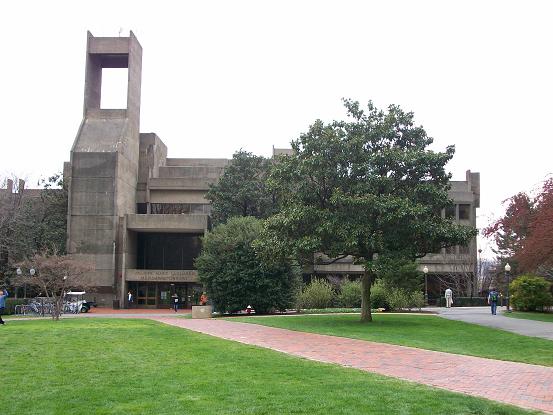
View from building: Impressive. These nearby buildings are very nice. But they’re not the library.
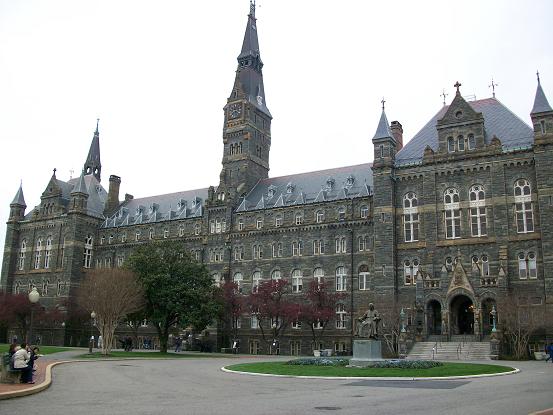
Religiosity: Jesuit. Pbbbbtht!
Holdings: Small, strangely conservative. Distinct gaps in Lukacs and Marxist criticism.
Staff: Patronizing, intrusive. Likely to lecture you about proper copier use. Likely to interrupt you repeatedly to ask why you’re enlarging things.
Things you’re not allowed to bring in: Snotty visiting scholar attitude; desire to Xerox without consultation.
Substantive work accomplished there so far: I’ve got the reader for my summer course 99% assembled. Most of the work took one marathon day.
Need to leave the building at some point: High. Virtually deserted; easy to spend twelve hours there; will drive you insane.
THE LIBRARY OF CONGRESS
Borrowing privileges: Not as such. The books you’re allowed to touch are delivered via conveyor belt to my study shelf, where I can keep them as long as I need them. I can take digital pictures of prints, photographs, and maps. I can pay for someone else to photocopy the things I’m not allowed to touch.
Ease of access: Farragut West to Capitol South. Piece of cake.
Hours: Limited, extremely punctual. Surprisingly variable between buildings, reading rooms, and days of the week.
Surrounding area: Government center. Opulent, impressive, purposeful. Also, perpetually under construction/renovation.
Building: Gorgeous. There are three buildings, of which the Jefferson Building is the main and the most beautiful.
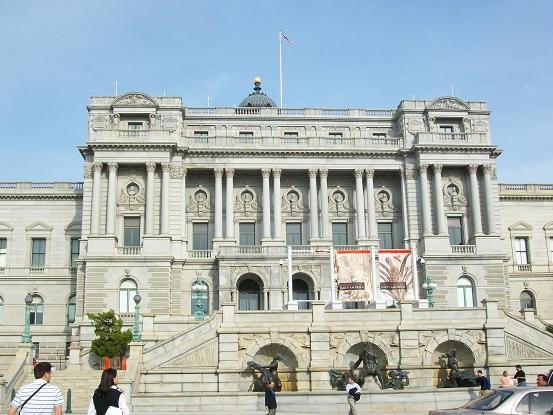
View from building: To your right, the Supreme Court. Straight ahead, that’s the Capitol.
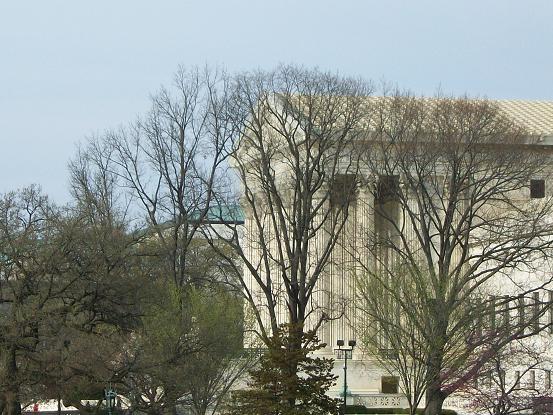
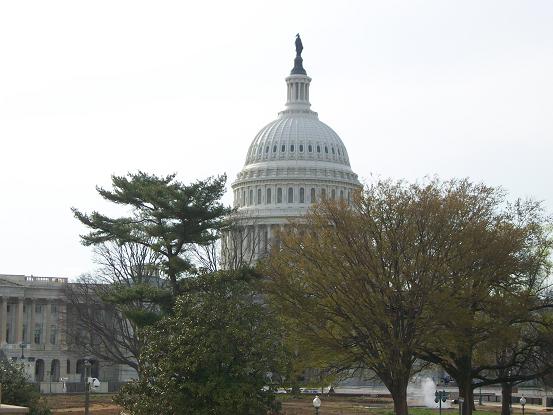
Religiosity: Separation of church and state, baby!
Holdings: More than 500 miles of books and other print materials. 10,000 new materials acquired per working day. Holy shit.
Staff: Patient, capable, helpful, friendly, welcoming. Deliver armloads of materials to you without you having to lift a finger. The one guy in the map room gets kind of annoyed when you don't know what you are looking for and are evidently fucking around, though.
Things you’re not allowed to bring in: Weapons, musical instruments, camping equipment.
Substantive work accomplished there so far: Unclear. I’ve looked at political cartoons and spent several hours locating funny place-names on 1890s survey maps. Oh, and I discovered that the San Fernando Valley, in which I grew up, used to have a slightly more desolate and Old-Westy name.
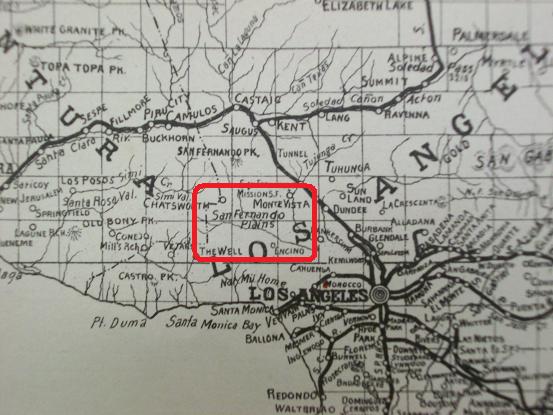
Need to leave the building at some point: None whatsoever. Large chunks of Capitol Hill are connected by a series of underground tunnels. The cafeteria on the 6th floor of the Madison building has better food than a lot of restaurants in Santa Cruz. It has its own credit union. The Library is basically a citadel. Oh, except they will kick you out at 5.
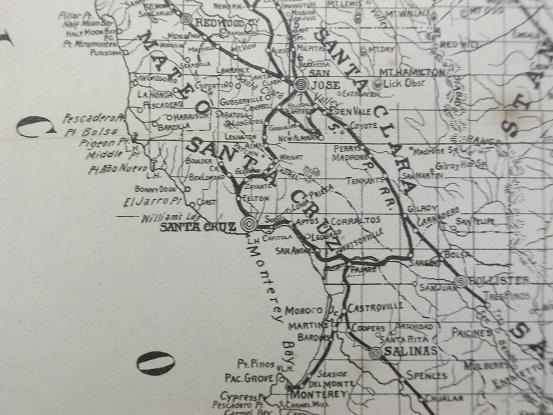
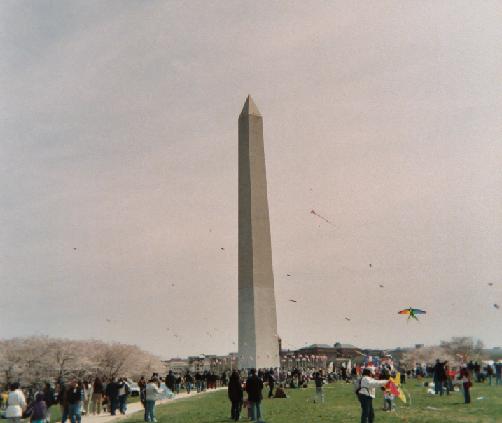
It may help you to appreciate the following if I stress that these represent the MOST worthwhile and decipherable pictures on the roll.
I got a halfway OK picture of the Washington Monument surrounded by kites. This was last weekend, when I was desperately sick, and went to the cherry blossom festival/ kite-flying competition with a couple of friends.
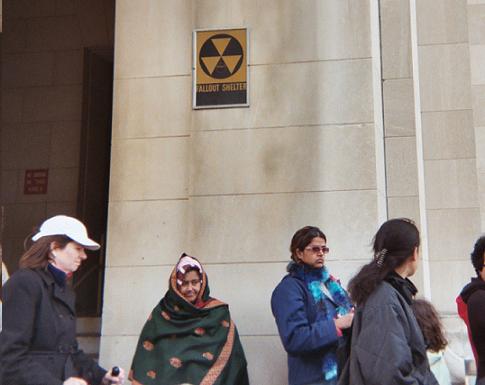
Then I got tired and had them point me toward the nearest Metro station so I could head back to the Center and sleep. On the way I apparently encountered a group of nuclear refugees – perhaps appropriate for a cherry blossom festival celebrating the history of “friendship” between the US and Japan.
The next night we went out for a nighttime tour of monuments. The White House is a lot smaller than I would have expected from the movies, but you’ll have to take my word for it because the beautiful set of size-comparison shots I thought I took of the little White House and its neighbor the enormous Treasury building didn’t come out at all. But that night wasn’t a total loss – I managed to capture evidence of the supernatural. Ladies and gentlemen, I give you the Ghost of the Lincoln Memorial!

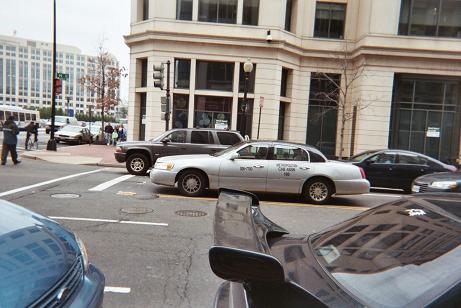
This next one took me quite a long time to figure out, because it appears to be a shot of a taxicab. I know I live in a smallish town back in California, but it’s not like I’ve never seen a cab before, so what the fuck? I had to stare at the picture for a really long time before I finally realized why I took it, which, because it was from before I had a camera with zoom, you won’t be able to see. Inside the building behind the cab, there’s a sign that reads “United States Mint.” The sign on the outside of the window is offering the building for lease. I’m taking this as a bad sign, folks – you might not want to lag on converting those dollars into Euros.
However, lastly, there’s this one. Even with my cold, even with my shitty disposable camera, I managed to take an absolutely lovely, jigsaw-puzzle, picture-postcard photograph of the Washington Monument framed by cherry blossoms.
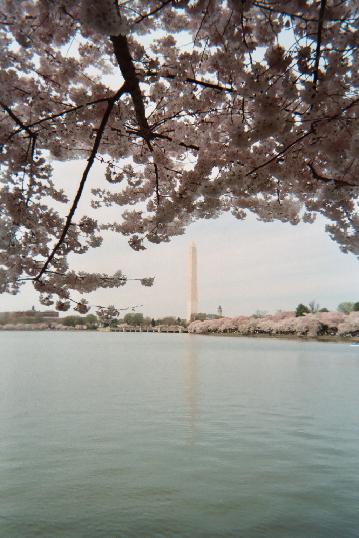
No, really, go back and take a long look, because I want you to get $14.28 worth of enjoyment out of that picture.
From now on, it’s OK, it’s all digital.
]]>Anyway, as I keep saying, I'm living in a great area. I was actually going to walk further around today, but spent a few hours just roaming my neighborhood taking pictures of shit.
This is the UC Washington Center building. I live on the top floor.
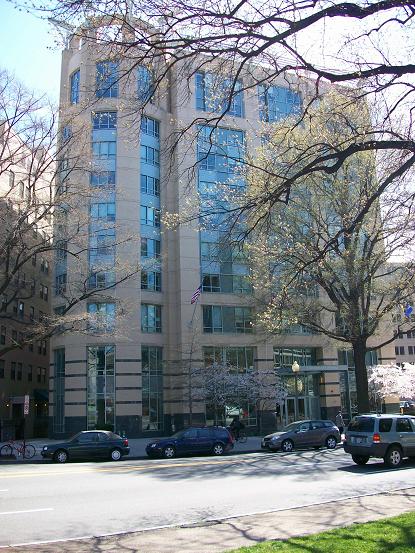
We're toward the end of a series of streets known as "Embassy Row." Here's the other end. All of these row houses are the embassies. On the left, Greece, um, Sweden, I can't remember what else. On the right, Ireland, Trinidad and Tobago, Luxembourg, Egypt, and Togo.

They're all about the same size, which means Togo gets about as much embassy as Egypt does. I think they should be proportional either to landmass or population, so that Ireland would have a regular house and Luxembourg would be in a kiosk.
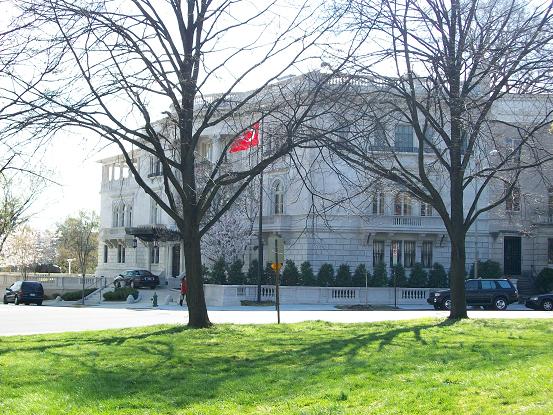
This monster is Turkey:
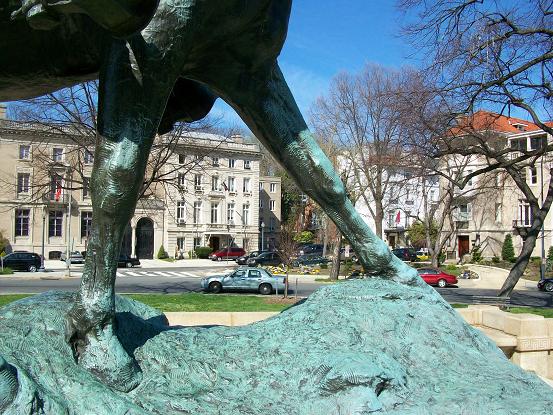
Here's a super-artsy shot I took of some more stuff through the legs of the horse in the statue of some guy named Sheridan:
Aaaaand the obligatory picture of my thumb, which probably is covering up something really interesting.
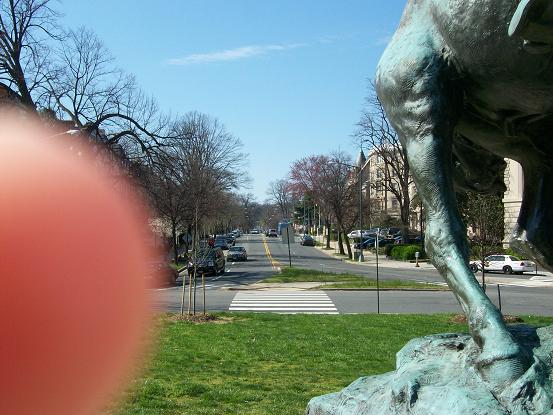
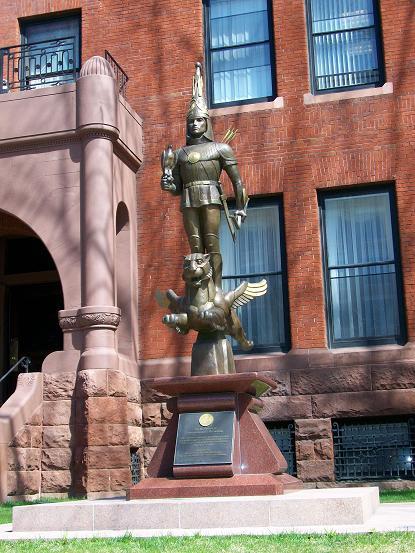
Yeah, I'm not the best photographer. Anyway, I'm at the other end of Embassy Row, and I think my favorite thing down at my end is the Kazakh embassy. This is their official statue of a knight riding a winged jaguar. It was put up last year, and I have to think that its seriousness is in some kind of response to Borat.
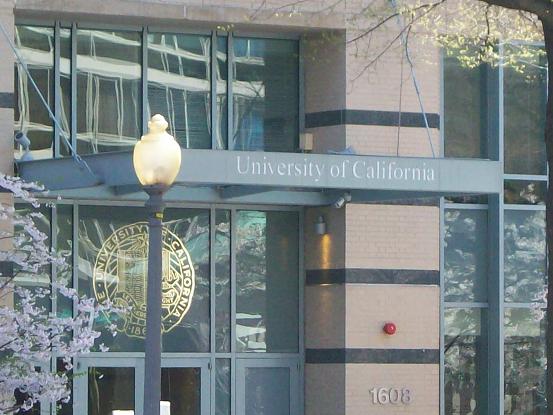
I like to think that I live in the California embassy.
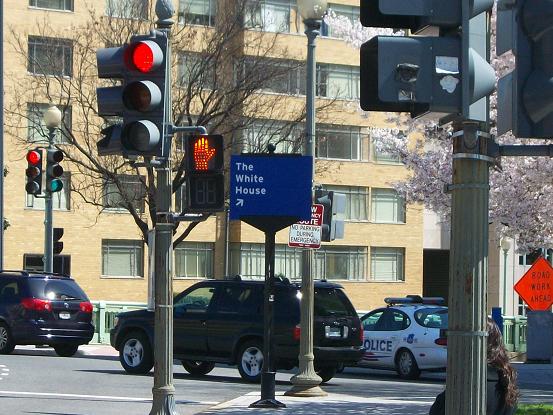
But the blue sign barely visible in the lower left of this picture insists, with total inaccuracy, that the White House is located inside my apartment,
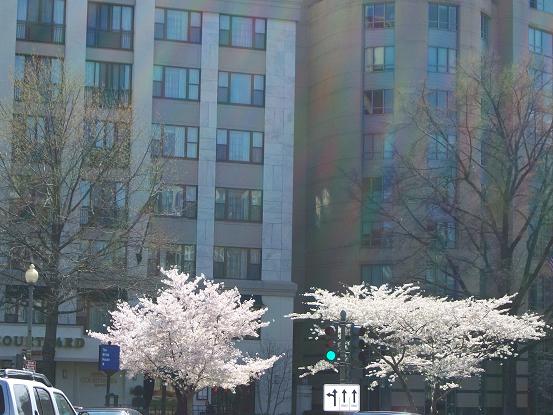
which is pretty much exactly where the arrow is pointing to.
We have a monument to Daniel Webster in the traffic circle right outside,

although when I first saw it I misread it as a Noah Webster monument and got all excited. We also are next to the Human Rights Campain building - see the equality flag on the roof?

A hell of a lot of the really cool buildings around here are churches. This is the one Teddy Roosevelt used to worship at:
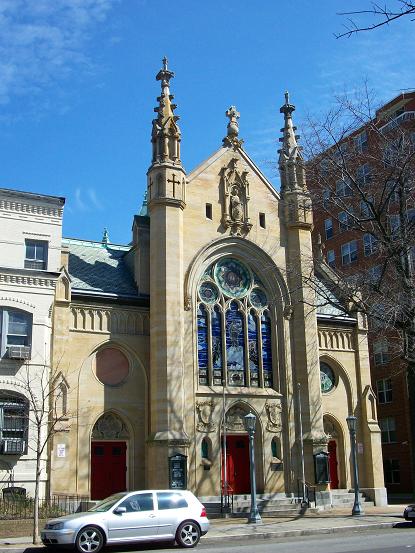
The plaque to the right of the door reads: "On this site in 1976, a historic plaque was affixed to this building."
This is another cool old building which actually isn't a church. The city is full of this shit:
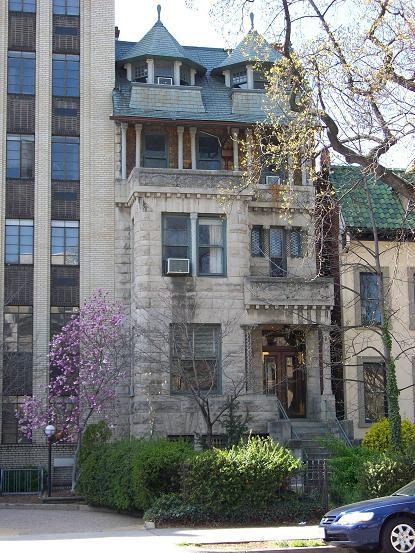
And, here and there, really fantastic high-modernist and postmodern architecture as well, like this building, which is an economic something or other:
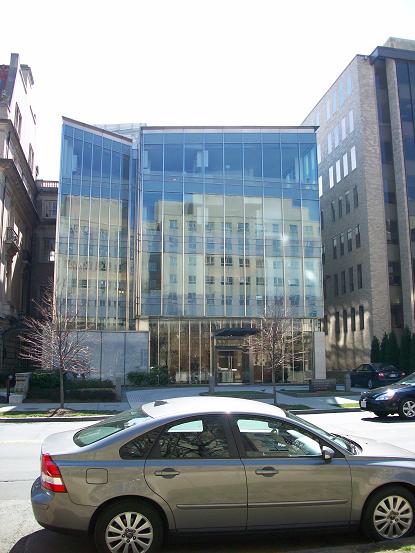
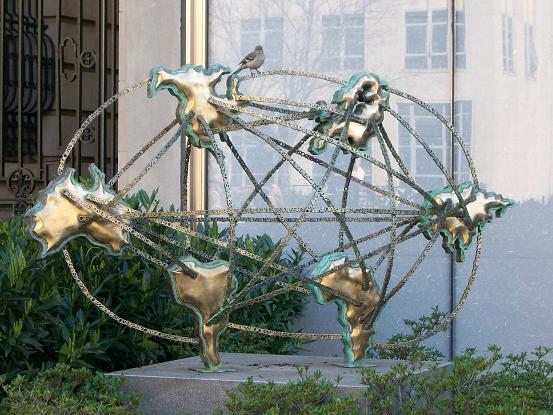
with an interestingly deconstructed globe out front (representing, um, globalization?). Note: this is a candid bird, not a stunt bird.
Finally, for your edification, a statue of a woman doing a poor job of covering her boobs:

And one of Taras Shevchenko, the Bard of the Ukraine:
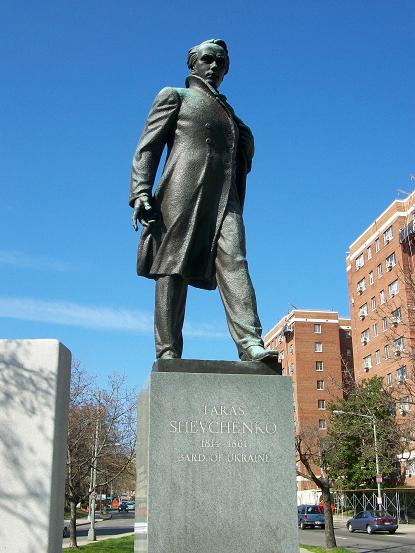
I don't know if his work is really as great as all that -- perhaps you can judge for yourself:

And a man wearing his napkin on his head while he eats lunch, for reasons which I suspect are clear to him alone:
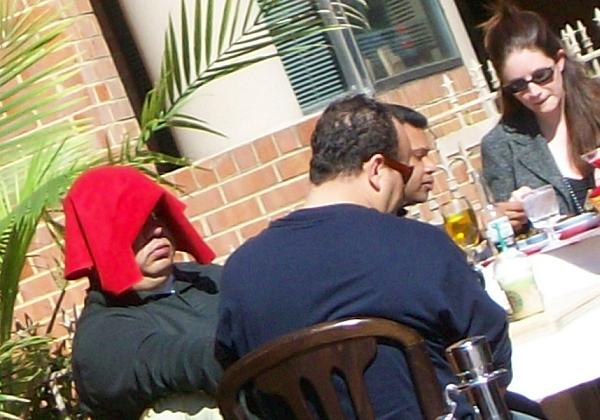
And lastly, the famed Dupont Circle,
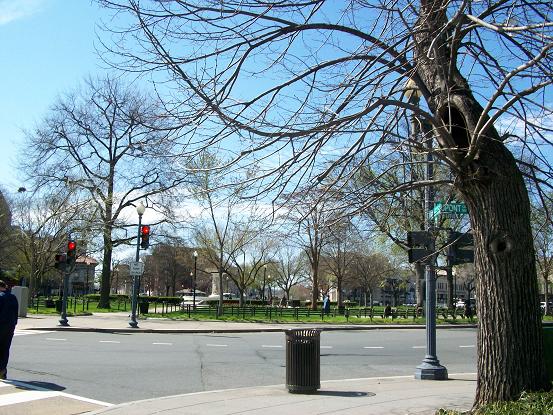
where there is a bookstore that has a bar in it, which is open all night. That is my kind of bookstore.
That's crap from about a five-block radius around my place. More substantive pictures when my film comes back from CVS, if it comes back from CVS. I'm going to get more selective about taking pictures, I think, although I'm currently feeling compelled to document everything, like our woefully expired elevator.

I spent a couple of hours brainstorming with the students about research paper topics about which they are far more knowledgeable than me. This is unsurprising, since most of them are econ and politics majors, and I only sound like I know about economics when I’m talking to other humanities people.
I came back to my apartment, which is essentially 1/3 of a hotel room, and had lunch.

Later my friend the Graduate Fellow (henceforth GF) from Irvine and I went to the bookstore and we got maps for our trip next weekend to Philadelphia. She’s got an actual conference to go to there; I just want to go see the city. So we’re splitting hotel costs and cheap bus fares. She called the hotel in Philadelphia to change her room from one large to two small beds.
“No,” she said on the phone. “There isn’t an extra person staying. I just…need an extra bed. For…medical reasons. Oh, you've removed the $20 extra person surcharge? Thank you.”
Then the law student from UCLA came over to see who wanted to go for late-night ice cream because it’s so warm and beautiful outside. The guy who lives in the apartment next to mine is a Community Advisor (henceforth CA) here in the Center, knows everything and everyone around here, and loves ice cream. So we walked over to Larry’s Ice Cream in Dupont Circle, which he claims is the best ice cream in the city. They were closing when we got there just past 10, but when the owner saw the CA through the window, they stayed open for us.
“What do you want?” the owner asked the CA.
“Oh, I’m doing great,” the CA said.
“What?” the owner asked.
“I’m great. Didn’t you ask how I was doing?” the CA returned.
“I don’t give a shit how you’re doing, my friend,” the owner said. “I asked what do you want?”
“Oh. A cone with Oreo cookie ice cream,” the CA said.
“That’s more like it,” the owner said.
I got Oreo ice cream too. UCLA got Reese’s peanut butter. As soon as we left with our cones, it started raining on us, fast and hard. We ran back to the Center in the warm rain, cones dripping all over the place. I finished mine right as we got back to the Center and the rain stopped.
Tomorrow I have another study day at the Library of Congress and then we have Poker Night.
Oh, and I got myself a present this afternoon: I broke down and got a fucking camera already. Because I am a Luddite and a latecomer to technology, this is exciting. Because I am a Luddite and a latecomer to technology, I'm still figuring out how to upload photos. I rationalized the purchase thusly: I was eventually going to spend the same amount of money on disposable cameras and film processing as I would on a low-end digital camera, without the benefit of zoom or, you know, picture quality. And evidently CVS is none too quick at the photo processing, because when I dropped my first disposable full of pictures off yesterday, the trainee clerk said, “Um, I think your picture CD will be back Wednesday.”
“Why’d you tell her that?” the manager asked. “You know it’s until Friday.”
“Really?” I said.
“You want these pictures?” the manager said.
So I have almost a week’s worth of updating to do, but it’s waiting until my pictures come back so I can remember what the hell I did. Nighttime tour of monuments; cherry blossom festival; Library of Congress; Georgetown; beer and darts; lots of getting lost.
I’d like to point out that technically I’m working right now.
There’s a particularly endearing Home Movies episode in which we find out that the kids have ended every single movie they’ve made with the exact same, identically intoned line: “It’s time to pay the price.” But the kids don’t realize they’ve been doing it, because every time, it seems like it’s the natural conclusion.
As many of you know, dear readers, I am living in our nation’s capital for the next three months, as the graduate fellow at the UC system’s study center here. As you may imagine, this has taken some planning and some time spent applying, securing recommendations, getting funding, strategizing, making research plans, and so on. The point is that I’ve been talking about this for awhile.
My charming father responds exactly the same way every time it comes up. Like the Home Movies kids, he delivers his line in a meaningful and ominous tone, and like the kids, I don’t think he realizes that he says the same thing, the same way, every time.
“Hey Dad,” I’ll say, “I’ve almost got my crap together to go to DC next quarter.”
“Oh, right,” he’ll say. “So you’re going to the scene of the crime.”
Today we had the following conversation:
Katie: Hi, Dad. Oh, wait. It’s really early there, isn’t it?
Dad: It’s about 7 AM. Where are you?
Katie: I’m in Washington. I just called to say I got in safely.
Dad: Oho, you’re at the scene of the crime?
Katie: Well, actually, I’ll be over there later this afternoon. Right now I’m in Virginia.
Dad: So you’re next to the scene of the crime.
Katie: Uh, yeah. I’m staying here until Wedn—
Dad: And then you’ll be at the scene of the crime.
Katie: Okay.
My father and I have rather different politics, and so over the months that he has delivered this identical line so many times, I have been unable to bring myself to ask him to which crime, precisely, he is referring. I have a horrible feeling that he actually means Whitewater, or maybe last year’s Democratic congressional victories. Or perhaps he’s expressing that most timeless of American sentiments: the absolute conviction that whatever the government is up to, it can be safely filed under the heading of No Good.
Even all the way from California, I’ve been able to pick up on the idea that Washington is a government town. I got that. What I didn’t extrapolate from that is the fact that, as a government town, and as a government town in what I suppose we might as well refer to as wartime, and as the seat of the military branch of the government, now, therefore, Washington is also a big time military town. I mention this because I’m unaccustomed to riding public transit or walking down the street with so many people in various kinds of uniform. I would have been less surprised if I’d encountered the humorless-looking guy in the full border patrol uniform back in LA, quite frankly, where we’re at least close to a border. Here, at the Pentagon City metro station, I wondered what border he could possibly be patrolling. The line between station and street? Is the sidewalk a border, or a liminal zone? But since he had a gun, I decided to keep my fucking trap shut.
It’s not that I’m dumb enough to be surprised that there’s a lot of security in the national capital or anything. But I’m not accustomed to how it feels, and it makes me uncomfortable to be surrounded by so many people who are essentially living representations of authority and enforcement. And while I also think that my home campus is a little cavalier about security, I was unprepared for the degree of lockdown at the Study Center here. I’m sure it will become normal in a day or two, but so far today the military-authority stuff is the thing that has thrown me the most.
It makes me keep thinking about my dad’s repeated (and repeated and repeated) one-liner about the scene of the crime. What’s going on here doesn’t feel to me like the scene of any real or specific crime – what’s here is actually a scene of criminality. All these uniforms and security measures everywhere are concrete, tangible manifestations of lawfulness and authority, and everywhere they are, they drag the suggestion of latent, intangible, indefinable danger with them. What’s safe and good is what you can see, and what’s scary and weird is the thing that hasn’t happened yet. But in a big staged battle between authority and criminality, the visible and the invisible, the known and the feared, I keep wondering: where is the place of the private citizen? At the scene of a crime that hasn’t happened yet, how do I know what position I occupy? For that matter, how does the guy in the uniform know?
This isn’t simply to complain about the military-industrial complex or my not-so-latent problems with authority. Washington seems like a great city so far, and I’m living in an awesome neighborhood. Christian’s mom chauffeured my ass around, drove me over cobblestones, provided me with a siesta, and fed me a chicken pot pie; the undergrads got a PowerPoint presentation on alcohol poisoning at their orientation. I’m fucking worn out from wrapping up the quarter, moving (thanks again, burly friends!), travel, and fighting this stupid cold. I’m going to sleep now in a comfy, comfy bed in Alexandria, VA, and tomorrow morning this house will be the scene of the crime when I steal Christian’s mother’s towels and sheets and take them to my extravagantly expensive, shoebox-sized apartment at the Center.
All Washington blog updates will be under the category The Scene of the Crime. Tomorrow’s possible topic: I’ve Always Depended on the Kindness of Strangers; or, Does Anyone Know Where My Linens Went?
Part II: Written now
I’ve gotten my internet connection and ID card problems sorted out, with the help of the IT guy, who is an American Studies student at U of Maryland. We hung out and talked about Stuart Hall while he took the world’s most unflattering ID picture of me and helped me sort out my clearances. So I’m already on my way to being inured to the military-authority stuff, since now I can actually enter and exit the building and use the internet to learn how to make napalm in my room.
The UC Center is awesome. It feels like back when I had a real job , with a desk, and keys, and a cubicle, and an ID badge. I have a library card for Georgetown. I have copier codes. I have had an agonizing meeting with the professor for whom I’m working re: the wording on our course syllabus and reorganizing the class so that I’m responsible for all the work. And then, magically, there was food in the lobby. It reminds me of when I was working at the dot-com. Actually, there’s also a dog in one of the offices here, and a TV dedicated to video games, so it’s almost exactly like my dot-com job, except that we never took a work field trip to Gettysburg.
It’s also reminiscent of my dot-com job in that I’m ostensibly getting paid but it’s not entirely clear what for. I sat down to set myself up at my cubicle, and five minutes later, I stood up and brushed off my hands. “Whoof,” I said. “There’s that taken care of. Guess it’s time for lunch.”
The main difference is that I have an “apartment” upstairs, by which I mean something that looks like what would happen if you built the world’s smallest hotel room in a hallway. I will try to post pictures later. In the meantime, I have to go back to Alexandria, pick up my other suitcase, come back, and then try to figure out where to buy food. The undergrads got another presentation on alcohol poisoning this morning. I immediately volunteered to chaperone every possible field trip, because this sounds like fun.
]]>Now imagine that the store you’re buying them from offers, for an extra couple of bucks, to include an appropriate pair of hiking socks with your boots. Let’s say it’s a special deal on buying the two together. “Great!” you say. “I need both hiking boots and hiking socks, and they have taken the trouble of finding some that go together and selling them both to me at a discount!”
Now let’s imagine that you’re halfway across the Grand Tetons in your extremely expensive hiking boots and conveniently included socks, when you realize what the store didn’t tell you: that they knowingly threw in a pair of socks that, in combination with the cushiony gel insoles of these particular boots, would cause your feet to catch fire. Q: Does this make any sense?
I have a new friend at the tech support call center who seems to have solved the mystery of why I’ve had three (3!) debilitating virus attacks, each requiring a full system wipe, in the two (2!) months I have owned my new computer. The issue becomes clear when I tell you a secret: the above story is merely a fable. Make the following substitutions to decode the secret meaning!
Sub COMPUTER for HIKING BOOTS
Sub OPERATING SYSTEM for CUSHIONY GEL INSOLES
Sub VIRUS PROTECTION SOFTWARE for HIKING SOCKS
Sub DEBILITATING VIRUS ATTACKS AND ERRATIC OPERATING SYSTEM PROBLEMS for FEET CATCHING FIRE
Yup: Stupid Dell runs Windows Vista (itself perhaps the most unpleasant operating system I’ve ever seen) standard on its products. They also bundle their systems with Trend Micro security software. But Vista + Trend Micro evidently = a whole host of problems that they’re still just hearing about.
This makes perfect sense, of course, if looked at from the point of view of strategic business alliances rather than that of technology. And since I know exactly jack shit about technology, then the former is in fact the only way that I can look at it. In fact, I’m kind of impressed by the company’s ability to tune out irrelevant bullshit about whether certain products work together, or whether they, as is in fact the case, mutually interfere and prevent each other from working.
Q: Why are you bundling these two things together?
A: We have made a deal to bundle these things.
Q: Do they work together?
A: We have made a deal to bundle these things.
Q: They don’t break each other, do they?
A: We have made a deal to bundle these things.
I finally got the solution to this puzzle last night when I was on the phone, spluttering mad, with my new friend at tech support.
“What do you mean?” I huffed. “You recommend these things to go together!”
The kid on the other end of the phone produced a prizeworthy Derisive Snort. “I don’t recommend this,” he said flatly. “The company bundles it.”
“Ah,” I said, as light dawned.
Because I am technologically retarded I don’t trust myself with dangerously anarchist operating systems and open-source software; I assume that anything that I can locate for free on the internet is filled with child-porn viruses; and I prefer not to do much else with the computer other than turn it on or off. (Although at this point I’ve gotten so I can restore the infernal machine to factory condition with no help, with one hand tied behind my back and while eating a sandwich.) This is why I wanted someone else to make all the decisions about software and OS combinations for me. Poor naïve Katie. All I wanted was to take the damned contraption out of the box and turn it on. I don’t want to learn about freeware. I don’t want to know what any of this stuff does. I just want it to do it.
Last night I finally just talked to the kid on the phone about what kind of system he has at home and what kind of security programs he’s running. Not at all the stuff his company sold me, but he told me he’s got basically the same system as me and has never had a real problem. I made him stay on the phone with me and spell out URLs letter by letter while I downloaded exactly the same programs that he has. I guess it’s a little like if I called from the Grand Tetons about my flaming feet and had a guy walk me through the process of taking off the combustible socks, filling my boots with free pine needles, and then sticking my feet back in. “Gosh,” I imagine myself saying, “that was easy and free. Are you sure that’s it?”
“Yeah,” I imagine the guy replying. “I’ve had pine needles in my shoes for like two years and my feet are fine. Feels better than burning socks, right?”
I wasn’t able to have this conversation on either of my previous two calls, because, of course, on all previous occasions I have been talking to extremely polite and well-mannered employees working at an overseas call center someplace. Both of the employees I spoke to had heavy South Asian accents and insisted that they had improbably white-bread names like Bob and Justin. Both evinced, in the manner of those not born on American soil, a work ethic, a willingness to stick to the script, and a degree of employee loyalty that made them ultimately completely unhelpful. “I am going to scream,” I would say somewhere during Hour Two of the phone call. “Send me a new computer or I will kidnap one of the children I seem to hear playing in the background and I will sell them on the organ market.”
“Yes, Missus Katie,” ‘Bob’ would say. “Do you mind if we start again with turning off the unit and once again pressing F8 many, many times?”
“Argh!”
My new friend, by contrast, sounded like a stoned, bored American college student or a stoned, bored out-of-work programmer – in other words, like exactly the kind of person I’m accustomed to speaking to. In the manner of the lazy, rude American worker, he cut right to the chase. “Oh Jesus,” he said. “This guy last night had somebody with exactly your problem and they spent like a million fucking hours on the phone trying to rule everything else out. Do you mind if we just start from scratch and I help you set up your system the way I have mine?”
“What, you mean the rational and easy way?” I asked, startled.
Both of the employees I spoke to at the Bengali call center spoke lovely and articulate English and were much better at differentiating between similar frustrated utterances than I am in any of the languages I’ve “studied.” They were unfailingly polite. But last night it was a profound relief to talk to someone who spoke my language.
“Thank fucking God,” I said.
“No shit, dude,” he said.
There are no long unbroken stretches of walkable beach in Santa Cruz – actually, I can’t think of any really long unbroken stretches of walkable beach between here and Mexico – but there are places where the elements are doing their best to create some. At Natural Bridges, if you stand on the beach and look back toward the cliff with the parking lot on it, you can see the remains of the staircase that has been covered over with mounds of sand and growths of hardy-rooted plants and incorporated into the cliff. Now there are no stairs, and you run pell-mell down a sandy hill to get onto the beach. On East Cliff Drive, there are about a million places where you can see the one remaining curb of the original road, most of which has long since become sand and hillside. On West Cliff, the only structure that remains on the windward side of the road – aside from the lighthouse – is a single house that sits on the one remaining outcrop of land that hasn’t fallen down the cliff and turned into beach. The house has been for sale for about as long as I’ve lived here, probably much longer, and will probably be for sale until it falls down, because a potential buyer would have to be both extremely wealthy and extremely short-sighted, two conditions that do not so often coincide in a country where wealth is more often accumulated by wresting it from someone else via savvy and acumen, rather than by inheriting it from a thousand years’ lineage of inbreeding and congenital aristocracy.
I’m not a huge fan of Robert Frost, but he did a pretty good job with this business of turning the precarious works of man through slow violence back into beach-blocking rubble, and finally into the beach itself:
You could not tell, and yet it looked as if
The shore was lucky in being backed by cliff,
The cliff in being backed by continent;
It looked as if a night of dark intent
Was coming, and not only a night, an age.
Since Frost wrote that in 1928, there’s been time to erect all these ill-advised structures along the coast and for them to be pried back off the continent by water, gravity, and plate tectonics.
More amazing still is this: The social and political landscape you see if you stand with your back to the water and look toward the continent has been entirely created by a desperation, born a little over 500 years ago in the minds of some misinformed Spanish dandies, to stand on this very beach. Everything that makes sense to us as a way of organizing the world, from our irrationally resolute belief that new reserves of depredated natural resources will magically appear just when we need them, to the inversely proportionate organization of labor for and access to those resources along racial lines, comes from the hidalgos’ persistence in using storybooks for maps.
The conquistadores came from a country that had been completely impoverished by its constant attempts to make war against the Moors, and, frequently, against itself. They were the remnants of the nobility in a country that no longer had the material wealth to support nobility, and they weren’t trained for any other job. As the late firebrand historian Bernard DeVoto wonderfully puts it in The Course of Empire: “They each had a horse, armor, arms, honor, courage, and an anarchic soul, and early in life most of them had little more.” They were trained for courteous existence and gentlemanly fencing, and wholly unequipped to sail long distances or do much of anything once they got here. And they were also untrained in the twin arts of poverty and earning a living; they knew only how to be wealthy, and the best way to become wealthy without earning it is literally to stumble across a pile of gold on the ground. There were, of course, no more such piles in Spain, all of them having been melted down to make the filigree around the hidalgos’ epee hilts.
This is where something that started essentially as a bedtime story transformed itself into a cultural myth and thence into hard geographical fact, and now, 500 years later, into geopolitics. Somewhere to the east of Spain lay what was variously an island, a country, and a small continent. On it were Seven Cities made entirely out of gold, because in a fairy tale, what other number could you have, and what else could they be made of? These cities were inhabited by naked people who liked strangers and showed this like by giving them gold. The strangers didn’t even have to dig for it themselves; they had only to show up on horseback with enough carrying capacity to get the gold back home. So the hidalgos packed light, carrying not nearly enough provisions for sailing, because they didn’t want to waste cargo space on food and water. Some of them actually made it to South America, which is itself something of a fairy-tale miracle considering that whenever they were confronted with oceanic and geographical facts that conflicted with the mythology of the Seven Cities, they tended to side with the storybook over the astrolabe.
One of the ones who managed to push across that continent was Pizarro, to whom I suppose this blog is obliquely dedicated. He wasn’t actually a hidalgo; he was an illegitimate son who was never formally educated and who worked for a time as a pig herder before shoving off for the New World. Because he was illiterate, he never read the myth of the Seven Cities, and because he was poor, he was forced to develop something of a work ethic and some survival skills. It was this combination of traits – pragmatism and handiness – that made him the right bloody fucking thug to slash and crash all the way across the continent to Peru.
Many things about his arrival there are unfortunate, not the least of which is the unspeakable savagery of his campaign and his dealings with the Incas. But perhaps more unfortunate for its long-range historical consequences is the fact that, unlike most of his compatriots, he actually did stumble into a country where even the gold was lined with gold. It was a highly developed society with complicated political and physical infrastructure and massive wealth, which turned out to be pretty easy for the conquistadores to take. It was proof positive that the Seven Cities were real, and were somewhere close by.
“It’s somewhere close by” became the catchphrase for the next several waves of gold-crazed hidalgos. They eventually ruled out South America as a location, leaving sugar ingenios and coffee plantations in their wake, and they stumbled up to North America. Everywhere they went they found evidence that the Seven Cities were just a bit further on. Someone would come back from a failed inland expedition with a tale of four encampments of teepees and no gold, and through the game of Explorer’s Telephone it would become a report of seven major cities with buildings of gold bricks. Desire rather than observation drew the maps well into the seventeenth century, and the maps showed that two things were always right around the corner: seven cities of solid gold, and a water passage to the Pacific Ocean, which was then called the South Sea. The water passage – sometimes called the Northwest Passage – was important because it would provide an easy way to get to Asia, which after all was the original point of all this westward sailing. This was the logic of desire: a water-based trade route would be much more economical and advantageous than a land-based trade route; ergo, it was inconceivable that such a thing might not exist. Just like mountains of gold would be a good thing to have; ergo, those existed too. For years, even generations, the maps of North America showed the continent in all different shapes – often most like a 200-mile-wide kidney bean – but always bisected east-west by a convenient network of waters.
No one would believe that this continent is as inconveniently large as it happens to be. They kept pushing across it, but there was little gold and no ocean. Feverish denial made every cluster of pueblos into cities of gold, and every body of water anyone hit or heard of was thought to be the South Sea. The Mississippi and Missouri rivers both briefly got that title, as did all of the Great Lakes in turn. There were more rivers, mountains, plains and deserts than anyone knew what to do with. This place was supposed to be an island a couple hundred miles off the coast of Spain. Instead it was bafflingly huge, impossible, unaccounted for in any of the stories, right in the way of the passage to India, too huge to go around, but it couldn’t go on forever, right? Right? So they kept moving West. Along the way, over several centuries, other countries took an interest and then took over; we got a few wars, the triumph of hardscrabble English frontierism over effete Spanish pseudoaristocracy and halfassed Russian grabbiness, some Indian removals, the birth of the modern republic, and, here and there, some gold, which is a lot more of a dangerous pain in the ass to haul out of the ground than anyone had thought or realized when they could make the Arawaks do it on pain of having their hands chopped off.
There is a very real sense in which modern California, as the eventual end of the hidalgos’ drive Westward, is a Spanish invention. During the push to get here, other stories got recalled and layered onto the myth of the Seven Cities, including one about a land of Amazon women ruled by a queen named Califia, filled with cool animals like griffins and covered with gold. The gentlemen’s rather understandable desire to find such a place – call it “Califia Dreaming” – sustained them through a lot of hard disappointments with other portions of the New World, and when they got here the California coast, fertile and shining onto the ocean, looked like everything the storybooks had promised, so we got the name California, the place where Califia lives with her one-breasted babes. We’ve got any number of cities here, glinting with gold and opening onto the Pacific, which is after all a straight shot to Asia if we want to take it. California was a huge coup for the Union both in terms of material wealth and resources and also in terms of the symbolic value of pilfering the crown jewel of Hispanic New World exploration, worth every penny of an easy two-year war with Mexico and then the 1850 Compromise that pushed us several notches closer to civil war (and took us from the lip-service Free-Soilism of the slaver Zachary Taylor toward the wishy-washy and untenable presidency of the chickenshit Millard Fillmore, and via his unreelectibility to Pierce, Buchanan, and finally to Lincoln).
The beaches around here are flecked with pyrite and mica, which makes the sand look like it’s full of gold dust, and I can take a short walk from my front door and stick my feet in the enormous bowl of freezing water the desire for which created the United States, both geographically and politically.
And why not? This place is all about willing appearances to become temporary, illusory realities. I grew up in Los Angeles, a Svengali of a city that built its wealth by providing people with charismatic images of the world as they’d rather it were, rather than how it is. I live here in Santa Cruz with imaginary student loan money that’s going to have to be paid back someday, but isn’t that California – perhaps all of the New World – in a nutshell? We build enormous houses on eroding cliffs.
I get to live here, I get a (measly, piddling, ruinous) salary from the government to go to school here, and a couple of miles away in the valley without an ocean view Hispanic migrant laborers are picking my lettuce. We got away cheap on this place, and sometimes it’s hard for me to make sense of what we’ve done with it, like building a hideous boardwalk and miles of senseless, crumbling highways on the lip of the biggest prize of the Age of Exploration and the object of every single continentalist American desire. I’m an atheist and I don’t believe in the wrath of God or anything like that, but I do think it’s fairly obvious that a more subtle moral and social cost accrues over time when you build a fairy-tale city on stolen land using unremunerated or barely remunerated labor. Maybe a small sense of impending justice – a small sense that we’ve got it just a little better here than we’ve earned – lies behind the quips about California splintering off and falling into the ocean, or at least behind the creepy satisfaction that I sometimes get from seeing the geography reclaim the roads and staircases and houses we’ve tried to stick here. Frost’s got that nailed down, too, because the actual end of the poem goes like this:
It looked as if a night of dark intent
Was coming, and not only a night, an age.
Someone had better be prepared for rage.
There would be more than ocean-water broken
Before God’s last Put out the Light was spoken.
Also, I really like the idea of living “off the grid,” and I continue to nurse a mental image of myself as the sort of person who would be ready to go do it if the timing were better. You know: too bad I’m stuck here in a small city doing the academia gig. Otherwise I’d totally be roughing it out in the mountains somewhere, my veggies not just organic but five minutes out of the ground, my shack authentically rugged and dilapidated but clean, my carbon footprint nonexistent, my flaccid arms toned and tanned from chopping wood and drawing water and making moose calls or whatever else you have to do to live in the woods.
As anyone who knows me can verify – hell, as anyone who’s ever even seen me can probably guess – I am really not a person who is cut out to handle anything other than prepackaged, sterilized, rounded-corners, amenities-included city life. I am, for one thing, hyperbolically terrified of spiders. For another, I am clearly unable to deal with ants in my living space. For a third, I am allergic to every plant and animal found on this planet. For fourth, I am extremely accident prone; let us remember that I am the woman who broke her hand last year by falling while walking down the sidewalk, and that a year before that I broke my foot by falling while walking down the stairs. For fifth, sixth, and seventh, I am afraid of the undead, the dark, and the prospect of losing my mind.
Eighth and worst, I have an utterly black thumb. As I walk down the street, grass browns and entire branches fall off trees, which is not just depressing but actually dangerous (see: accident prone). Last year a friend left me in charge of his cacti when he was out of the country; all I can think is that he must not have been adequately warned about what I do to plants. I managed not to kill his plants, but only because I refrained from touching them for the entire year. Literally. I left them to their own devices, and they limped along until he was able to reclaim and resuscitate them. I had optimistically purchased a small cactus of my own and placed its pot near my friend’s plants. For the whole year, my cactus survived right alongside them, probably because I was ignoring it. As soon as he came back and took his cacti away and mine realized that it was being abandoned to my “care,” all its pods fell off and it died. I tried recently, again, with two houseplants. I picked two fairly hardy plants allegedly suited to the conditions in my apartment. After a two-week regimen of erratic watering, manhandling, and verbal abuse, one plant collapsed over the side of its pot and the other turned into a trail of leaves that I still haven’t gotten around to vacuuming off the floor. As for actual gardening, I tried over the summer to thwart the evil feral cats in my neighborhood by planting dandelions in their litterbox, also known as the dirt under my bedroom window. Nothing. Dandelions, which are famous for growing anywhere instantly, refused to grow in the best-fertilized six square feet of ground in Santa Cruz. Amazing.
Pretty much the only plant I haven’t managed to kill is the gigantic cactus occluding the door to my apartment, but I do seem to have induced in it a disfiguring disease. I tried to trim it back a few months ago, but I lacked any of the appropriate tools for the job. I’m not sure what those tools would have been – something to protect my hands from spines, maybe, along with something designed to cut through big succulent pads – but you know what didn’t really work so well? Hitting the more obtrusive pads with a hammer until they fell off or buckled. I managed to knock a bunch of them off and cripple a lot more, but they grew back, big, spiny, and covered with huge scabrous spots of moldy-looking crusty sap. It got really gross and blocked the door to the point where the FedEx guy got mad because he got stuck with spines trying to hand me a package, so yesterday I went outside and kicked at the cactus until some more of the paddles broke off. I’m sure this time it’s going to grow back even worse, although I’m not sure how it will manage that. Maybe by becoming carnivorous or something. Man-eating zombie cactus: you see why I fear the undead.
The point is that all this bodes very ill for me ever being able to live on my own away from civilization, with its beguilingly convenient roster of exterminators, physical therapists, exorcists, mental health professionals, and food retailers.
I am a very good cook; my skills in the kitchen appear to be inversely proportionate to my skills in the garden. I can do a lot with not much, my instincts are excellent, my finickiness an asset, my knowledge of principles solid, my stock of tools full and appropriate, and it almost never happens that I do something that simply can’t be saved. What I can do with the edible bits of plants is totally different from what happens when I’m faced with the whole plant. For this reason, I am a big fan of packaged foods and food ingredients. Every time I open a bag of beans or rice or greens, I know that someone else, someone capable, took care of the growing part. Then a clean, shiny, chrome food-packaging robot took the food and put it in a bag, and somebody trucked it to a store and someone else put it on a shelf and I bought it and so really, all I need to do is the good part: eat.
However, I think I may need to work harder on my gardening skills and rethink my comfy reliance on packaged ingredients. This is because a couple of recent events with some of my most beloved foods has shaken my belief in the gleaming metal hygiene of the food-packaging robot and stirred up yet another one of The Fears That Will Keep Katie From Living in the Woods: the Fear of Germs.
At the risk of sounding like a weirdo, I love lima beans. Specifically, I love frozen lima beans, because the freezing process allows each bean to retain its beautiful, delicate green luminosity, with its subtle scalloping, and its wonderful mealy beany texture, and its light yet substantial flavor which is utterly unlike the flavor of canned lima beans. Canned lima beans taste like can and are suitable only as filler in recipes you don’t really care about. Frozen lima beans, simmered briefly and tossed with nothing more than your favorite butter substitute, sea salt, and fresh pepper, are a heap of little glossy green revelations. The little baby ones are firm and equally good on their own or in soups, stews or pastas. The big Fordhook ones are plump and soft and should be eaten alone, one at a time, speared with a fork. They were the first vegetable I would eat without a fight as a child, and still, as an adult, I go through maybe a bag of frozen lima beans every week or two. Until a couple of weeks ago, when I took the bag of frozen lima beans I had purchased from a major national food retailer, cut off a corner, and began to tip them into a pot of simmering water. Out came some lima beans, and on top of the heap of little green beans came a frozen rat turd.
I owned rats for several years and spent some of the less glorious moments of my life picking pieces of rat shit out of the carpet. I know what rat turds look like. Thanks to the freezing process designed to allow each bean to retain its own boundaries and personality, the rat turd in question was perfect, complete, and individually frozen. It was unmistakable. I haven’t eaten a lima bean since.
Another thing I eat a lot of is a sort of basic risotto I make with a variable cast of ingredients that depends on what I have and what I feel like. It tends to be something like a few different kinds of rice for texture, with various broths/sauces, vegetables, and spices, depending on what angle I’m going for. A nice place to start is with ½ cup each of brown, wild, and basmati rice, added at various times according to the amount of time each needs to cook, and then various veggies and so forth. Beans are good here too, in order to make a whole protein, but limas don’t stand up. Soybeans are toothier and better. Anyway, as much as I like rice-based things, sometimes I don’t feel like taking the time or the dishes to start from scratch, and so I like experimenting with various kinds of prepackaged rice-and-herbs combos, and then adding veggies and ingredients from there. I recently purchased, from a regional chain of health-and-specialty-foods-stores, a rice mix that was basically basmati and wild rice with a sort of lemon-herb blend. I was going to make it as the basis for my dinner tonight, and was about to cut open the clear cellophane package, when I noticed a gigantic wiry black hair inside. The hair was huge. It went from one end of the package to the other, trapped in the seal on both sides. I’m willing to bet that on one of the ends of that hair, curled inside the package seal, there’s a follicle. This wasn’t a little hair, or a maybe hair, or just sort of a hair. This was a hell of a hair.
While I’ve just finished laying out all the ways that I’m clearly not cut out for a solitary outdoor life, I also don’t think of myself as a total Howard Hughes type. I don’t spend a lot of time thinking about other people’s germs unless they do something to remind me about it, like walking into a restaurant with grimy bare feet with parking lot debris embedded in them. Also, I wantonly stick my fingers in my mouth all the time, even when I’ve been touching doorknobs or money or traffic cones, a fact which may go some way toward explaining why I’m sick all the damn time. But I’m really not OK about stuff in my food. When we had to dissect grasshoppers in seventh grade, I became convinced that a grasshopper leg would detach itself and cling to my sleeve where it would wait for the opportune moment to drop into my lunch. For some reason, this put me off of peanut butter sandwiches for almost a year, because this was where I thought the leg would wind up: stuck in the peanut butter, glued to the roof of my mouth. OK, looking back, I think that I may have been a little unhinged about it.
But this is the quandary I find myself in: I can’t eat my beloved packaged foods here in the city, because my food-packaging robot has turned out to be some lady not wearing a hairnet and slacking on cleaning the rats out of the bean chute. And I can’t live in a cabin in the woods, where all my vegetables will die and spiders could fall out of the roof beams into my sad bowl of dead stems. The only remaining solution, I think, is to become an astronaut, floating in my pod in antiseptic zero-gravity, effortlessly eating freeze-dried chowder out of a foil pouch. Until I bite into something that turns out to be a severed thumb, and then we find out if it’s true that in space, no one can hear you swear your damn head off.
]]>The day pretty much went downhill from there.
I'd like to give a "shout out" to the jerks at the laundromat, my car, all undergraduates, my phone, ants, my iPod, my tooth, and my computer. You all know who you are.
Also, my car now receives only the following two radio stations: the terrible college station, which was playing a very long earsplitting song that sounded like funk mixed with opera, and a station calling itself "The Positive Alternative" which plays Christian hits for not-so-edgy youth. And interviews with Jars of Clay about their missionary work in Africa. Seriously, who knew Jars of Clay was still around?
I see what's going on here, though. Just because you're sticking it to me isn't going to make me believe in you, you jerk.
]]>A few years later I learned from one of my graduate student instructors, one of the nicest and most perennially fatigued and harried educators I had at Cal, that it is totally still possible to write a dissertation on any of the most over-read, over-analyzed, beaten-to-death famous literature if you want to; you just have to find an angle no one’s taken before. This GSI was such a nice fellow that I don’t want to run any risk of his finding his dissertation snickered about in my blog, because I’m about to explain why I think about him every single day as a cautionary example of how badly a dissertation project can get out of hand if you’re not careful. So I’ll simply explain that his dissertation was on a topic very like the use of prepositions in Danish translations of D.H. Lawrence. Very, very like that. And when he would explain what he was in the middle of working on, years in and apparently with quite a way to go, it was totally evident that he had no idea how he’d gotten there and that he’d never, as a stoned, naive undergrad, pictured this as his life’s work. But this is what happens if you want to write a PhD dissertation on D. H. Lawrence nowadays: you have to find some angle that no one in his right mind would already have taken.
The pit of Danish prepositions yawned beneath me when I started grad school with dreams of writing a dissertation about the single most feted and written-on – and best – author in US history. But I appear now to have marched myself down the other path, which involves hunting down and writing about stuff that no one’s written a thing about or even heard of, which will preferably lead to finding a book so obscure that only one copy was ever printed and that one was remaindered immediately. The good thing about this is that if there turns out to be one single thing worth saying about that book, I’ll damn well be the only one saying it.
Unfortunately, the novels I’m interested in are all popular fiction, all dealing with the same subject, all written during a specific historical period before TV, when people were desperate for entertainment and would read anything as long as it wasn’t the almanac again, and all genre fiction, which means they’re all the same. In my apparently endless quest for the ever-more-obscure, the lost-to-history, the ready-to-be-rediscovered, I have read approximately a million of these novels in the last several months, and I’m now prepared to share my initial findings. Ladies and gentlemen, history seems to do a pretty decent job of deciding what it’s going to preserve and what can go ahead and get lost to it. It’s not like all these novels are awful; some are great. But some are bad.
As a budding connoisseur of the bad book, I’ve learned a few things. One is that not all bad books are immediately unworthy of reading; some of them are actually quite bad in very interesting ways, and some are at least interesting although they are quite bad. Another thing I’ve learned, at least about the kind of historical fiction I’m reading, is that contrary to what you might think, the more stupid and outlandish the characters’ names, the better the book is likely to be. This is a purely statistical observation. If your main characters have names like Eliphalet or Pinetop or, God help me, Miss Pussy, the book’s probably at least going to be a well-paced and interesting read. If they’re all named John and Betsy, brace yourself, because you’re in for 400 pages of nothing. One of the things to keep in mind about this is that, while I cannot find any record of such a law on the books, I have inferred that some legislation must have been passed in the mid-1880s requiring every novel to contain at least one beautiful young woman named Virginia and at least one male personage named Ezra; these names are therefore strictly to be excluded from consideration in assessing the probable quality of the book. If the setting of the book happens to be antebellum, the male slaves are required to be named Cornelius, Shadrach, and Scipio, and the novel is likely to throw in an actual Aunt Rhody and Uncle Ben just to be safe; this is likewise unworthy of notice.
It’s also kind of amazing how many novels start the same way, with some kind of Mad Libs variant on:
Toward the close of a [Month] afternoon in the year 18[Year], Miss [Spinsterish First Name] [Jarring and Arrhythmic Last Name], having learned by heart the lesson in [Subject] she would teach her senior class on the morrow, stood feeding her [Name of Domestic Animal] on the little square porch of the [Puckered-Sounding English Name] Academy for Young Ladies.
or, for the masculine version:
[Virile and/or Biblical First Name] [Name of Ice-Cream or Donut Franchise], Esq., of [Last Name From Above] Hall, in the county of [Name of Former British Monarch], was no inconsiderable man in his Lordship’s province of [State], and indeed he was not unknown in the colonial capitals from [Obscure Village] to [Long-Abandoned Backwater].
Those templates are from Ellen Glasgow’s Virginia and Winston Churchill’s Richard Carvel, respectively, but really they could be from any of about a hundred novels. No, not that Winston Churchill.
Given that so many of these novels are very, very similar, it’s always nice to find one that has its own thing going on. This week’s darling is S. Weir Mitchell’s novel In War Time.
In case the name S. Weir Mitchell doesn’t ring an immediate bell, he was a famous doctor in the second half of the 19th century. This was just as modern psychology was developing and before it was professionalized, so I don’t know quite what to call him, but he was an early head-shrinker who specialized in female nervous disorders – basically, what the medicine of the day called neurasthenia, which was Greek for “feeling blue, agitated, and cooped up because your lot in life ain’t so hot.” He developed the preferred “cure” for neurasthenia, which was, of course, enforced bed rest and utter deprivation of company, sensory input, and mental stimulation. He was the doctor who confined Charlotte Perkins Gilman to her bed and drove her insane, and at whom she wrote “The Yellow Wall-Paper” after she escaped and ran away to California and married her cousin, and before she killed herself. (In case, like me, you like to immediately go and look these things up for yourself, she calls him out by name on the fifth page.)
Oh, and in 1884 something possessed him to write a Civil War novel.
Like any good monomaniac, he certainly sticks to his theme. Reading his novel, you’d hardly know there was a war on, except insofar as it provides background for him to talk about such things as:
The medical profession, changes in;
Neurological research, the importance of;
Shutting up and lying in bed, the advisability of;
Women, the social-climbing aspirations of;
Teenage girls, the childlike qualities of; and
Young doctors these days, deficiencies of.
War also comes up vaguely in order to furnish the occasion for one wounded soldier to develop a disorder called “pyaemia,” which at that time apparently meant “figuring out that your hospital roommate is probably the guy who shot you,” and it sometimes comes up in the passages in which Mitchell, in a philosophical moment, is wont to reflect on Moods, the changing nature of. This is a passage about how our young protagonist Dr. Wendell is Not Having a Good Day:
With some people, their moods are fatal gifts of the east or the west wind; while with others, especially with certain women, and with men who have feminine temperaments, they come at the call of a resurgent memory, of a word that wounds, of a smile at meeting, or at times from causes so trivial that while we acknowledge their force we seek in vain for the reasons of their domination.
That’s actually kind of lovely, but do not think that this dreamy stuff, this damned poetry, is all that this novel is made of. No, within two sentences we’re talking about the balance of humors in the body, and then this happens two pages later when we catch up with our effeminate Dr. Wendell on his walk home:
He was rapidly coming to a state of easier mind, under the effect of the meerschaum [pipe]’s subtle influence upon certain groups of ganglionic nerve cells deep in his cerebrum, when, stumbling on the not very perfect pavements of the suburban village, he dropped his pipe[.]
It is also important to note that Dr. Wendell, possessed though he may be of a nervous disposition, and (as we are told on page 5) not a little adversely affected by having to walk past trees with reptilianly-textured trunks, is himself a good enough nerve doctor to spend most of the early pages of the novel popping into patients’ rooms and telling them to shut the hell up and lie still.
In addition to his interesting approach to medicine, Mitchell is also the only person I have ever encountered who, when endeavoring to describe a fifteen-year-old girl upon a train, would choose to evoke her youth and freshness thusly:
But this little existence, now sent adrift from its monotonous colony of fellow polyps to float away and develop under novel circumstances, was a very distinct and positive individual being.
Or, several pages later, to sketch her heart-rending reunion with her dying father the pyaemic in this charmingly clinical manner:
He made no sign in reply. Nature had not waited for man to supply her anaesthetics, and the disturbed chemistries of failing life were flooding nerve and brain with potent sedatives.
The novel keeps going and going; we talk about virtue and toothbrushes, whether sponges can be considered alive, why it’s a good idea to have three pen-wipers on your desk, statistical evidence in favor of vaccinations, and how to confess love to a girl when you only know how to talk like a 19th-century medical textbook. You might think this sounds like a bad book, and it probably is, but I think it’s great. It’s kind of a rib-tickler, although I can’t tell whether it’s meant to be, especially because Mitchell doesn’t sound like a guy with much of a sense of humor about his profession. Better yet, although there’s an Ezra, at least so far there’s no damn girl named Virginia with roses in her hair. There are microscopes and surgeons instead of swords and cavaliers, nerve tonic and milk punch instead of juleps and Confederate Pickle. Contrary to my hypothesis, it moves along nicely for a novel without a single Lemmuel or Jeff-Jack or Aunt Pittypat in its pages, no white men named Powhatan, no Brother Tombs, no Rainy-Day Jones and no slave named Leviticus. Even more surprisingly, Mitchell seems to have allowed all his female characters to get up and walk around and do things; only the soldiers are confined to their beds, left to pick at the wallpaper in the amputee wing of what is actually called, so help me, the Stump Hospital.
And anyway, it does not do to nitpick or fault-find or look at things too closely, for, as Mitchell reminds us, “If our eyes were microscopes and our ears audiphones, life would be one long misery.” True words, my friends, true words.
]]>